






You have 400 webinar registrants, 109 MQLs, and a content library that your competitors would trade their budget for. So why is your sales team still waiting for the phone to ring?
This is the quiet frustration sitting inside most B2B tech media companies in Singapore right now — and it does not get talked about enough. The content engine is running. The audience is growing. The engagement metrics look healthy. But when you trace that activity back to the actual pipeline, the numbers do not match up. If this sounds familiar, the problem is rarely your content. It is what happens — or rather, what does not happen — after someone engages with it.
This is exactly the gap that modern lead generation for tech media companies is designed to close, and the companies solving it fastest are doing something very specific that most others have not caught onto yet.
Get qualified tech media leads.
See how B2B tech media companies are getting real sales conversations — not just engagement metrics.
The Real Reason Your Pipeline is Not Growing (And It Is Not Your Content)
Here is something most B2B tech media companies in Singapore get wrong: they measure audience engagement as a proxy for pipeline health. Page views are up, so the pipeline must be building. Webinar attendance grew, so the sales team should be getting busier soon. Download numbers are strong, so MQLs are on their way.

But engagement and pipeline are not the same thing — and conflating the two is precisely what creates the gap.
The deeper issue is structural. Tech media firms operate in a uniquely complicated commercial environment that most B2B pipeline advice simply does not account for. Your audience is also, in many cases, your competitor pool. The publishers, demand gen agencies, SaaS vendors, and marketing services firms you are trying to sell to are often the same companies producing content that competes directly with yours. Consequently, a one-size-fits-all outbound approach does not just underperform here — it can actively damage relationships you have spent years building.
This overlap means that pipeline generation for tech media firms requires something more precise than standard demand generation. It requires knowing not just who is in your audience, but which of those accounts are actively in a buying mindset right now — and reaching them with messaging that speaks to exactly where they are in their decision process.
Not sure if your current approach is leaving pipeline on the table?
Callbox works with B2B tech media companies across Singapore and APAC to close the gap between audience engagement and sales conversations.
Your Audience Data Is a Sales Intelligence Asset — Are You Treating It That Way?
This is the insight that separates B2B tech media companies that grow their pipeline from those that keep recycling the same MQL pool year after year.
As a tech publisher or demand generation firm, you already own one of the richest layers of first-party buying behaviour data in the B2B space. Every time a target account visits your sponsored content hub three times in a week, every time a senior marketing decision-maker registers for your webinar and then downloads your post-event report, every time a specific topic starts generating repeat traffic from a cluster of accounts in the same vertical — that is not just editorial insight. Those are B2B intent signals. They are telling you, with reasonable precision, which companies are currently evaluating solutions in your space.
Most tech media companies sit on this data and use it to report on content performance. The companies building a serious pipeline use it to trigger outreach.
The distinction matters enormously. Because by the time a high-intent account has consumed multiple assets, attended a virtual event, and started comparing vendors, they are almost certainly having similar conversations elsewhere. Waiting for them to fill in a contact form — or hoping a nurture email sequence eventually moves them forward — hands the advantage to whoever reaches out first with a relevant, timely conversation.
This is exactly the kind of visibility that Callbox builds into every campaign for B2B tech media companies in Singapore — mapping buying-behaviour signals against a verified ICP to ensure outreach lands with genuinely in-market accounts, not just recently active ones.
How a Singapore Tech Media Firm Turned Audience Data Into a Pipeline
A Singapore tech media firm went from referral-only to a structured, multi-market pipeline across 7 APAC markets — in just six months. See the full breakdown of how they scaled their pipeline with Callbox.
READ CASE STUDYWhy Outbound Is Not Optional for B2B Tech Media Pipeline Generation
There is a version of this conversation that gets stuck on the inbound versus outbound debate. That framing misses the point entirely — especially for tech media companies in Singapore whose buyers are sophisticated, busy, and evaluating multiple vendors simultaneously.
Inbound is essential. It builds authority, generates organic traffic, and creates the content assets your audience actually wants to consume. However, inbound is passive by design. It puts the timing of a sales conversation entirely in the hands of the prospect — and in complex B2B tech sales environments, that timing is rarely when it suits your pipeline targets.
Outbound prospecting, on the other hand, gives your team control over timing. When it is informed by the right data, outbound does not feel like an interruption. It feels like a relevant conversation arriving at exactly the right moment. That is the difference between cold outreach and data-driven prospecting — and it is why the most effective demand generation strategies in Singapore and across APAC are built on both, working in tandem.
The framework looks like this in practice:
- Inbound creates demand. Your content, SEO, webinars, and syndication build awareness and bring the right audience into your ecosystem. This is the long game, and it is non-negotiable for brand authority.
- Behaviour signals identify demand. As your audience engages with your content, patterns emerge — which accounts are returning frequently, which topics are generating spikes, which decision-makers are showing up at your events. These signals tell you who is in-market before they tell you themselves.
- Outbound captures demand. A structured, multi-channel outreach program engages those high-intent accounts at the right moment, through the right channels, with messaging that is specific enough to earn a response.
This is the foundation of account-based marketing for B2B tech companies — and when all three components work together, the impact on pipeline velocity is significant.
What Effective Outbound Actually Looks Like for Singapore Tech Media Companies
The execution detail matters here, because outbound done poorly is worse than no outbound at all — particularly in the tech media space where your reputation and relationships are part of your product.
The most effective outbound programs for B2B tech media companies in Singapore share several characteristics:
1. They start with a precise ICP, not a broad list.
Before a single email goes out or a single call is made, the highest-performing campaigns are built on a tightly defined Ideal Customer Profile — combining firmographics, technographics, buying behaviour, and market signals to surface the accounts most likely to convert.
Callbox’s AI-powered ICP Generator does exactly this, analysing multiple data sources to identify and prioritise accounts showing active buying triggers such as hiring activity, funding events, or product usage patterns.
2. They run on multiple channels simultaneously.
Decision-makers at B2B tech companies in Singapore are not sitting in their inbox waiting for a cold email. They are on LinkedIn, attending virtual events, reading industry content, and taking calls — on their own schedule, across multiple touchpoints. Effective outbound meets them across all of these channels in a coordinated sequence, not a one-and-done message blast.
Callbox’s Smart Engage platform orchestrates this across voice, email, LinkedIn, chat, and events — ensuring every touchpoint is tracked, timed, and connected.
3. They use distinct messaging tracks for distinct audiences.
As the case study above illustrates, tech media companies often need to reach buyers and potential channel partners through the same outbound program. These are fundamentally different conversations. Sending the same pitch to both destroys credibility and wastes pipeline. Thoughtful segmentation and persona-specific messaging are what make the difference between an outbound program that opens doors and one that quietly burns bridges.
4. They treat webinars and events as pipeline tools, not just content plays.
Virtual events and webinars are one of the highest-value touchpoints in the B2B tech media sales cycle — but only if the pre-event recruitment and post-event follow-up are structured around pipeline generation, not just attendance numbers. There is a meaningful difference between running a webinar and running one that actually moves the pipeline, and it comes down to how you recruit, engage, and follow up — something we break down in detail in “How Elite Teams Win at Webinar and Virtual Event Marketing.”
A well-run webinar campaign builds a warm, engaged audience that your commercial team can follow up with context and credibility. A poorly run one generates a list of names that go cold within 48 hours.
5. They keep the human layer front and centre.
AI and automation accelerate the targeting and sequencing, but the conversation itself requires human judgement, adaptability, and genuine relationship-building — especially at the decision-maker level. The most effective campaigns combine AI-powered precision with experienced SDRs who know how to move a conversation forward without pushing a prospect away.
The Pipeline Mistakes Most Singapore Tech Media Companies Are Still Making
Even with the right strategy in place, there are several patterns that consistently undermine pipeline generation for B2B tech media firms. Recognising them early saves both budget and time.
1. Treating all engaged contacts as equals.
Not every MQL deserves the same level of outreach urgency — and when your team fails to tier leads by intent level, the cost runs in both directions.
A contact who downloaded one whitepaper six months ago and a contact who has attended two webinars, visited your pricing page, and opened three emails in the past two weeks are not the same lead. When outreach treats them identically, SDRs waste time chasing low-intent contacts while high-intent accounts go cold and, eventually, land on a competitor’s calendar instead.
2. Waiting too long to follow up on high-intent signals.
Buying behaviour is time-sensitive, and intent data has a shelf life. An account that was actively researching a solution this week may have already made a shortlist decision by next month, and an account that was in-market last month may have already closed the door entirely. Fast follow-up on fresh signals is one of the highest-leverage actions your team can take, yet it is consistently where the gap between marketing activity and pipeline conversion is widest. The opportunity does not wait — and neither do your competitors.
3. Over-indexing on automation at the expense of relevance.
Automated sequences are efficient, but when every prospect receives the same message regardless of their specific behaviour, engagement, and response rates fall quickly. Personalisation that references the content consumed, the event attended, or the topic researched is what separates outreach that gets replies from outreach that gets ignored.
4. Not validating intent signals against your ICP.
High engagement does not automatically mean high fit. An account can show strong buying signals and still be completely wrong for your solution — wrong size, wrong market, wrong stage. Without cross-referencing behavioural data against a well-defined Ideal Customer Profile, your SDRs end up chasing activity rather than opportunity. The signal tells you who is looking; your ICP tells you whether it is worth the conversation.
5. Skipping the human layer.
AI and automation do the heavy lifting on targeting, sequencing, and timing — but they cannot replace the judgment, adaptability, and relationship-building that actually move a conversation forward at the senior decision-maker level. The best-performing outbound programs treat technology as the engine and human expertise as the steering wheel. One without the other either goes nowhere or goes in the wrong direction.
6. Running outbound without proper sales and marketing alignment.
When marketing is passing raw MQLs to sales without context, and sales is following up without understanding what those leads actually engaged with, the handoff process breaks down. Pipeline generation requires both teams working from the same data, the same playbook, and the same definition of what a qualified opportunity actually looks like.
7. Trying to build outbound capability entirely in-house, without enough bandwidth.
This is the most common mistake for tech media companies specifically. A small commercial team stretched across retention, upsell, and new business development simply does not have the capacity to run a structured, multi-channel outbound program at scale, which is exactly why the client in the case study above was sitting on APAC pipeline potential it could not reach.
Recognise any of these in your current pipeline program?
Callbox helps B2B tech media teams in Singapore fix the gaps — from ICP validation to multi-channel outreach execution — without adding headcount.

Top Lead Generation Agencies for B2B Tech Media Companies in Singapore
Choosing the right partner depends on where the gap in your pipeline actually sits. Here is a practical breakdown of the leading agencies in Singapore, matched to the specific needs they serve best:
1. Callbox Singapore
Callbox Singapore is a natural fit for B2B tech media companies whose pipeline and content strategies need to work as one. With over 20 years of B2B experience, Callbox specialises in lead generation and appointment setting, events lead generation (webinars and live events), data enrichment, and AI-powered multi-channel ABM — operating as a full commercial extension of your team across voice, email, LinkedIn, chat, and events.
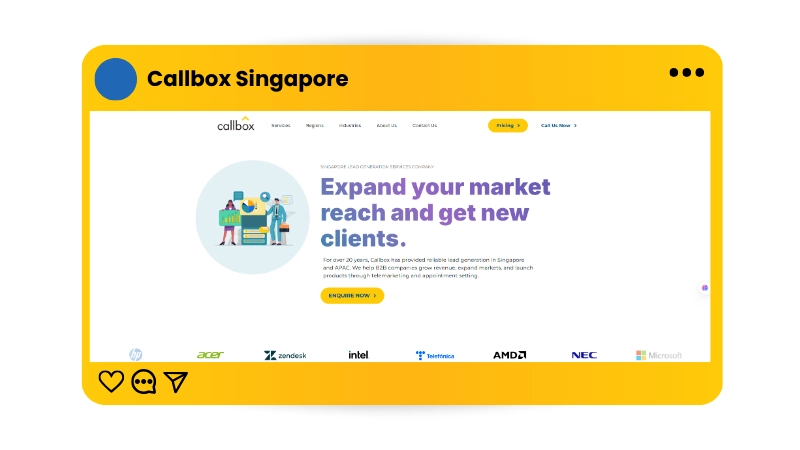
Their proprietary Smart Engage platform ensures every touchpoint is tracked, timed, and connected, making them particularly effective for tech media companies running multi-market outbound programs across APAC. Industry leaders, including Salesforce, AWS, and Google, trust Callbox to drive consistent pipeline growth.
2. IMPACT!
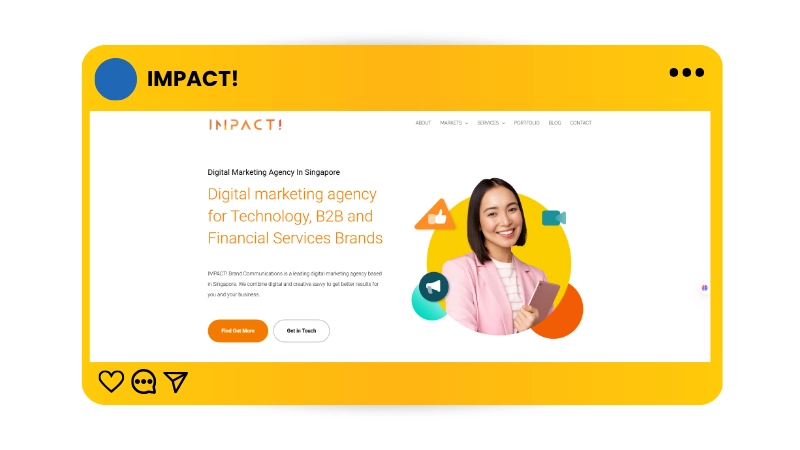
IMPACT! specialises in B2B tech and fintech marketing, helping companies build authority through content-led lead generation and SEO. A strong fit for tech media firms looking to strengthen their content foundation alongside their commercial activities.
3. Construct Digital
A data-driven B2B agency with a focus on technical content and lead generation. Construct Digital brings strong analytical rigour to campaign measurement — well-suited for publishers who prioritise pipeline attribution and reporting.
4. Konsyg
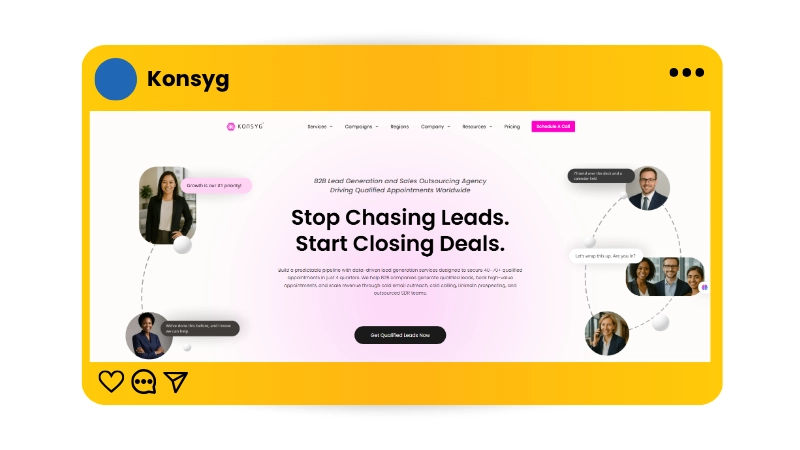
Konsyg provides on-demand sales teams for SaaS and technical media platforms. A practical option for media companies that need to stand up an outbound sales function quickly without building permanent headcount.
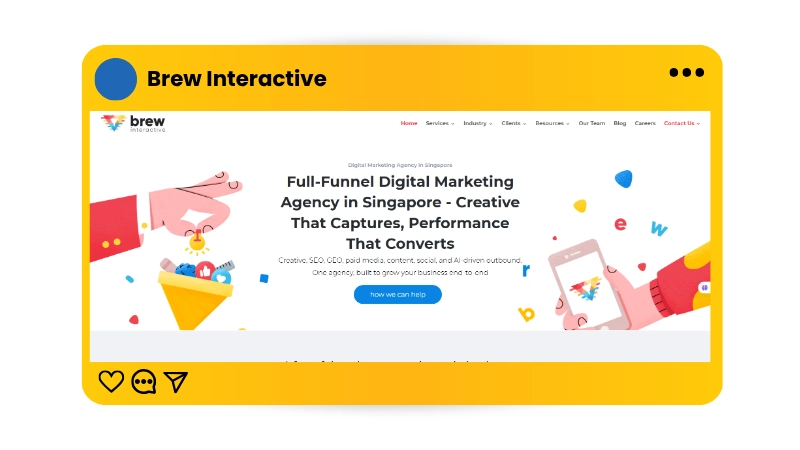
5. Brew Interactive
BrewInteractive is a growth agency using content marketing and paid social to accelerate B2B pipelines. Useful for tech media companies looking to amplify their inbound engine through paid channels.
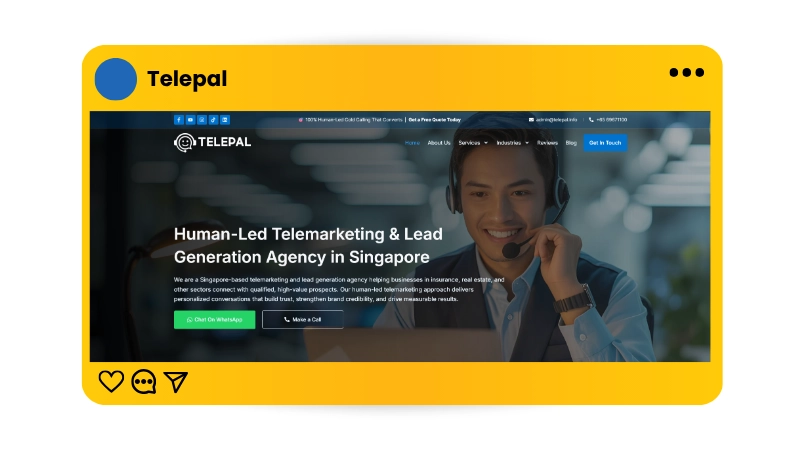
6. TelePal
TelePal focuses on appointment setting and cold-calling for complex enterprise tech solutions — a strong option for media companies targeting large enterprise accounts where human-to-human engagement is essential.
What Results Can B2B Tech Media Companies in Singapore Realistically Expect?
When B2B tech media companies in Singapore build their pipeline on a foundation of data-informed outbound — rather than passive inbound alone — the impact across key metrics is consistent and measurable.
- Higher SQL rates. Because outreach is focused on accounts showing active buying behaviour, a significantly higher percentage of conversations progress to sales-qualified opportunities compared to traditional MQL-based nurturing. You are not casting a wider net — you are casting a smarter one.
- Shorter sales cycles. Engaging prospects when they are already in-market compresses the time from first conversation to proposal — in some cases by weeks. When a prospect enters the pipeline already informed and already evaluating, your sales team is not starting from zero.
- Better lead quality. Sales teams spend their time on accounts that are genuinely exploring solutions, rather than following up with passive subscribers who downloaded a report out of curiosity three months ago. That shift alone changes the energy and productivity of your entire commercial team.
- Improved marketing-to-sales alignment. When marketing delivers context-rich, behaviour-informed leads rather than raw MQL volume, the handoff process becomes more productive — and the relationship between both teams improves because they are finally working from the same picture.
- Scalable, predictable pipeline growth. Unlike event-driven lead generation, which spikes around campaigns and drops off in between, a structured outbound program creates a continuous flow of qualified opportunities. That consistency is what sustainable commercial growth for a tech media company actually looks like.
Frequently Asked Questions
Why isn’t inbound marketing enough for B2B tech media companies in Singapore?
Inbound builds awareness and brings the right audience into your ecosystem — but it is passive. It puts the timing of a sales conversation entirely in the hands of the prospect. Without a structured outbound layer to engage high-intent accounts at the right moment, you are leaving the pipeline to chance in a market where your competitors are not waiting.
What are B2B intent signals and why do they matter for tech media companies?
B2B intent signals are behavioural indicators that suggest an account is actively researching or evaluating a solution — repeated content consumption, event attendance, topic surges, and similar patterns. For tech media companies, these signals are especially valuable because they are generated directly by your own audience. Using them to inform outreach timing and prioritisation is one of the most effective ways to improve pipeline conversion rates.
How does account-based marketing work for B2B tech media firms?
ABM focuses pipeline generation resources on a defined set of high-value target accounts rather than generating volume leads. For tech media companies, this approach works particularly well because it allows for the precise, persona-specific messaging needed to navigate the overlap between potential buyers and potential channel partners — without compromising either relationship.
What makes outbound prospecting effective in Singapore’s B2B tech market?
Effective outbound in Singapore’s B2B tech market requires a tightly defined ICP, multi-channel execution, persona-specific messaging, and — critically — the human expertise to carry conversations forward at the decision-maker level. Automation accelerates reach, but human judgment closes the gap between a response and a qualified sales conversation.
How do you combine inbound and outbound for maximum pipeline impact?
Inbound attracts and educates. Outbound activates and converts. Together, they form a full-funnel demand generation strategy where inbound builds the audience, and outbound ensures that the highest-intent accounts in that audience are engaged at exactly the right time — rather than waiting for them to find their own way to your sales team.
What type of companies benefit most from this approach?
B2B tech publishers, demand generation agencies, content syndication firms, marketing technology companies, and SaaS providers with complex, multi-stakeholder sales cycles benefit the most. Essentially, any tech media company in Singapore whose pipeline depends on reaching senior decision-makers across multiple markets at the right moment in their buying journey.
Your Audience Is Already Telling You Who Is Ready to Buy
The pipeline potential inside most B2B tech media companies in Singapore is larger than it looks — but it is locked inside audience data that is being read as editorial metrics rather than sales intelligence. The accounts you need to reach are already engaging with your content. The signals are already there. What is missing, for most teams, is the structure and capacity to act on them before a competitor does.